

Contested Divorce Lawyer Huntsville, AL
If you are going through a contested divorce in Huntsville, and one or both of you cannot reach agreement on property, custody, support, or some combination of all three, that means a judge in Madison County Circuit Court will ultimately make the decision if you and your soon-to-be-ex do not settle. Our Huntsville, AL contested divorce lawyer prepares every case as though it will go to trial, because that preparation is what creates real negotiating leverage and produces strong outcomes whether the case resolves at mediation or in front of a judge. Managing Partner Stephen Williams has handled contested family law cases throughout Madison County since earning his Alabama State Bar admission in 2010. He holds a Juris Doctor from the University of Alabama School of Law and an MBA from the University of Alabama. Reach out today to schedule a consultation with the Foxtrot Family Law legal team.
Why Choose Foxtrot Family Law for Contested Divorce in Huntsville, AL?
Trial-Ready Preparation from Day One
Most contested divorces in Huntsville settle before trial. But the ones that settle well, on terms that actually protect the client, settle that way because the attorney on their side came prepared to litigate if necessary. When opposing counsel knows you are not ready for trial, that changes what they will accept. When they know you are, it changes the conversation entirely. We’re prepared, we’re tenacious, and we’re squarely on your side.
Stephen Williams began his legal career working under a former juvenile judge, developing an early and direct understanding of how Alabama courts evaluate evidence, weigh credibility, and decide contested family law matters. He is licensed by the Alabama State Bar, and is admitted to practice before the United States District Court for the Northern District of Alabama, and the Eleventh Circuit Court of Appeals. That appellate experience matters in contested cases because some disputes do not end at the trial level. As your divorce lawyer in Huntsville, AL, we know the difference between a case that should settle and one that needs to be litigated, and we discuss both options honestly and openly with our clients..
Credentials That Hold Up Under Pressure
Stephen Williams has been recognized as a Super Lawyers Rising Star every year since 2019 and holds a “Superb” rating on Avvo. He is a member of the American Bar Association’s Family Law Section, the Huntsville-Madison County Bar Association, and served as President of the Marshall County Bar Association in 2014. His MBA gives him a direct and practical understanding of the financial analysis that contested property division cases often demand.
A Practice That Handles Nothing But Family Law
Foxtrot Family Law handles family law exclusively. No criminal defense, no personal injury, no business litigation. Every contested divorce case we take gets the full attention of a firm whose entire infrastructure is built around family court. We know how Madison County Circuit Court handles contested divorce proceedings, what discovery looks like in complex cases, and how judges in this jurisdiction approach the issues that most frequently drive disagreement between spouses.
★★★★★ “Foxtrot Family Law was very helpful during our time with them. They were responsive and knowledgeable. They knew our case would have challenges and they faced them and were ready for them at every turn.” – Elizabeth Clonts
Read more reviews on our Google Business Profile.
Types of Contested Divorce Cases We Handle in Huntsville
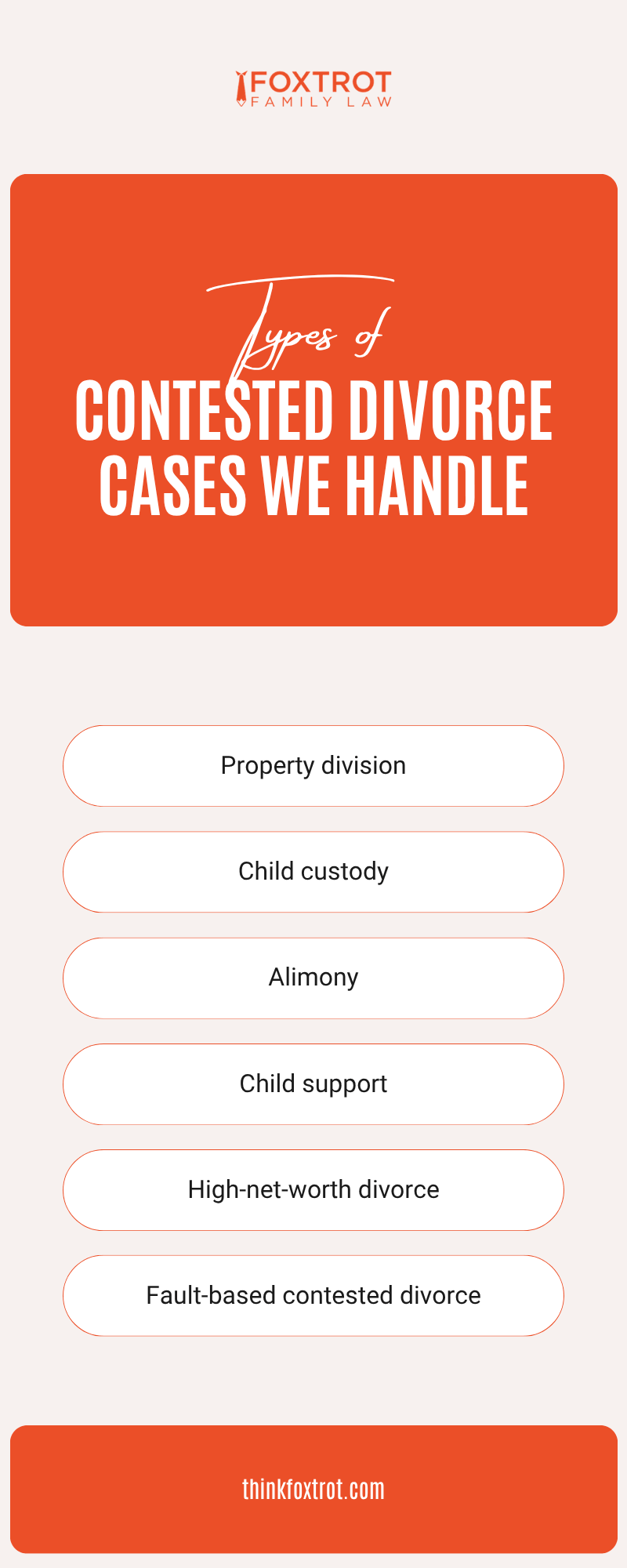
Contested divorce is not a single dispute. It typically involves several overlapping disputes, each requiring its own legal strategy. Here is what we handle for clients in Huntsville and Madison County.
- Property division. Alabama is an equitable distribution state. When spouses disagree about what belongs in the marital estate, what assets are worth, or what a fair division looks like, those questions become contested issues for the court. We build the financial record needed to support our client’s position, including working with forensic accountants and valuation professionals when the estate is complex.
- Child custody. Custody disputes are the most emotionally charged part of most contested divorces. Madison County Circuit Court applies Alabama’s best interest of the child standard to every custody determination, and the outcome depends heavily on documented facts, not just assertions. We prepare custody cases with the same rigor we bring to property and financial disputes.
- Alimony. Spousal support is disputed in many contested cases, both as to whether it is warranted and in what amount. We represent clients on both sides, building the factual record on income, standard of living, and earning capacity that these disputes require.
- Child support. Alabama’s income-shares model provides a baseline, but high-income cases, self-employed spouses, and disputes over income characterization all push support questions into contested territory. We address the financial documentation and legal arguments that drive these disputes.
- High-net-worth divorce. When the marital estate includes business interests, investment real estate, retirement accounts, or executive compensation, contested proceedings become substantially more complex. Asset tracing, valuation disputes, and QDRO preparation all require close attention in high-asset cases.
- Fault-based contested divorce. When a client wishes to pursue a fault-based ground, whether adultery, abandonment, domestic violence, or another ground under Alabama law, the contested proceeding requires affirmative proof. Fault can affect property division and alimony outcomes in ways that make it strategically significant. We assess whether pursuing fault grounds serves a client’s interests before advising them to take that path.
Alabama Legal Requirements for Contested Divorce
A contested divorce in Huntsville proceeds as civil litigation in Madison County Circuit Court, governed by Alabama’s divorce statutes and the Alabama Rules of Civil Procedure. Understanding how the process works, and what the law requires at each stage, matters from the day the complaint is filed.
Under Ala. Code § 30-2-1, a contested divorce may be filed on no-fault grounds, most commonly irretrievable breakdown of the marriage, or on any of Alabama’s fault-based grounds, including adultery, voluntary abandonment for one year, habitual drug or alcohol addiction contracted after marriage, imprisonment for two years under a sentence of at least seven years, domestic violence, or mental incapacity following five consecutive years of institutionalization. Fault-based grounds require affirmative proof at trial. They can, however, influence how the court divides assets under Ala. Code § 30-2-52 and may affect alimony outcomes as well.
The process after filing follows a predictable sequence. One spouse files a complaint. The other spouse has 30 days to file an answer and, if warranted, a counterclaim. Discovery follows, during which both parties exchange financial documents, answer interrogatories, and may conduct depositions under the Alabama Rules of Civil Procedure. Either party may request temporary orders under Ala. Code § 30-2-8.1 covering custody, support, and exclusive use of the marital home while the case is pending. Those interim arrangements often set the practical baseline that carries into final negotiations.
After discovery, most contested cases move through pre-trial motions, potential mediation, and then either settlement or trial. A contested divorce in Alabama typically takes six to eighteen months to resolve, depending on the complexity of the issues and how quickly each side moves through discovery. Property division follows Alabama’s equitable distribution framework under Ala. Code § 30-2-51, with the court dividing the marital estate fairly but not necessarily equally. The Alabama Unified Judicial System and the Alabama State Bar both provide public resources for Madison County family court proceedings.
Huntsville Contested Divorce Infographic
Important Aspects of a Huntsville Contested Divorce Case
Contested divorce cases in Madison County involve recurring pressure points that shape the outcome more than most clients anticipate when the case begins.
Temporary Orders and the Early Advantage
The first contested hearing in a divorce case often matters as much as the final one. Temporary orders establish interim custody arrangements, support obligations, and who stays in the marital home while the case is pending. These arrangements have a way of becoming the baseline for final negotiations, because judges and parties both grow accustomed to what is already in place. Getting temporary orders right is not just about the short term. We move quickly when a client needs immediate relief and position temporary order hearings as the strategic opening of a longer case.
The costs and dynamics of contested proceedings should be understood before a client commits to litigation. We discuss that plainly at the start of every engagement, because informed clients make better decisions than clients operating on assumptions.
Discovery and Financial Transparency
Contested divorces require full financial disclosure from both sides. Both parties must produce income documentation, asset records, account statements, tax returns, and other financial materials in discovery. In cases involving business ownership, self-employment, or complex investment portfolios, the financial picture requires careful analysis. When a spouse’s income is understated or assets are obscured, we identify those issues through interrogatories, subpoenas, and, where necessary, forensic accounting.
Clients who want to rush through the process to get the case over with often sacrifice the discovery phase, and that sacrifice tends to show up in the final outcome. We do not cut corners in discovery because we know what corners cost.
Custody Disputes Inside a Contested Divorce
When custody is contested alongside property and support, the emotional stakes intensify considerably. Courts in Huntsville expect documented evidence of each parent’s role in the child’s life, the stability each household offers, and each parent’s willingness to support the child’s relationship with the other parent. Allegations of misconduct, domestic violence, or substance abuse add procedural complexity. We understand how high-conflict custody disputes interact with contested divorce proceedings and address both tracks simultaneously rather than treating them as separate matters.
Understanding physical versus legal custody distinctions matters in contested proceedings because the two types of custody can be divided differently, and opposing counsel often focuses on one while obscuring the implications of the other. We build positions on both clearly from the start.
Mediation in the Contested Process
Alabama courts frequently order or encourage mediation before a contested divorce goes to trial. Mediation is not capitulation. Done properly, with a client who is fully informed and an attorney who has built a strong litigation file, divorce mediation can produce a resolution that is better for the client than what a judge would order, because the parties retain more control over the outcome. We represent clients in mediation as assertively as we do in court. A weak mediated agreement is still a binding legal order that can take years and additional litigation to undo.
When Cases Go to Trial
Some contested divorces in Huntsville do not settle. When a case goes to trial in Madison County Circuit Court, a judge hears evidence, evaluates credibility, and issues rulings on every unresolved issue. Both parties present witnesses and exhibits. The standard for property division, custody, and support does not change at trial, but how effectively you present the relevant evidence to the court does. We prepare trial presentations with the same discipline we bring to discovery and motion practice. A contested divorce trial is not a moment to improvise.
After a trial, either party may file a motion to alter, amend, or vacate the judge’s order within 30 days. An appeal must be filed within 42 days of the final ruling or the ruling on any timely post-trial motion. We advise clients on post-trial options when the outcome warrants it.
Contact Foxtrot Family Law
A contested divorce in Huntsville demands a lawyer who is prepared for every stage of the process, from the first temporary order hearing through trial and, if necessary, appeal. You’ll get that, and tenacious advocacy, from our Huntsville contested divorce lawyer. Foxtrot Family Law represents clients throughout Madison County in contested divorce matters with the preparation and directness these cases require. Contact us to schedule a consultation. We respond to new inquiries within one business day and take the time to understand your full situation before giving you any assessment of where your case stands.